Eight
Why the Lines Matter
 By Frank A. Figueroa
Eight
By Frank A. Figueroa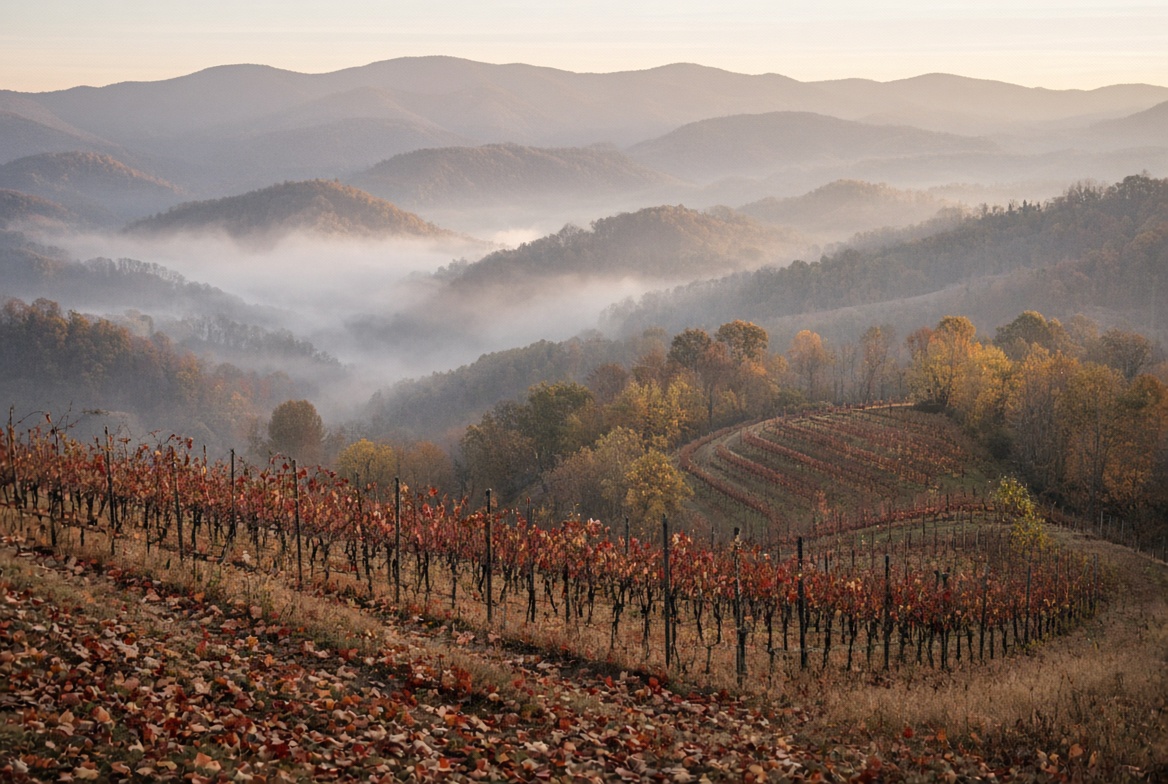
A person who wants to find this high country still has to learn more than one name.
North Georgia Wine Country is the name these notes use. On a federal map the same ground is split between the Upper Hiwassee Highlands and the Dahlonega Plateau. Both names are real and both describe air, slope, and a cluster of vines, but neither one is the whole of the high country. A reader meets the pieces first and has to put them together.
A line on a label is useful. It tells a buyer where the fruit was grown, it lets a restaurant list a place instead of a single estate, and it gives a grower a name that can travel past the tasting room. What it does not do is decide which ridges belong together. The mountains do not stop where either line stops, and good vines already sit outside both. A person driving from one tasting room to the next can cross a federal line without noticing it. The slope feels the same, the night is still cool, and the fruit still has to be matched to the ground. The line stays on the paper while the work stays on the ridge.
That gap has a cost. A visitor learns one cellar and leaves with that cellar’s map. A sommelier in Atlanta asks for a name and is handed the Upper Hiwassee Highlands and the Dahlonega Plateau. A writer who wants to say the place plainly has to choose between the larger high country and the federal lines, as if they were rivals, but they are not. One is the ground itself, and the others are only the names the law has already given parts of the high country. A buyer who only knows one name can miss the rest, and a grower outside both lines can make a good bottle and still have no regional name to put beside it.
None of this makes the existing lines wrong. They were drawn for a reason, and they still do the work they were drawn to do. The Upper Hiwassee Highlands was Georgia’s first appellation, and the Dahlonega Plateau came after. Each one names a real stretch of ground and is honest about the cluster it covers. The question is what a person can do with them. A name that covers only part of the work is honest, and it is also incomplete. The high country is already being farmed as one place, but the map has not yet caught up with the work.
These notes have looked at the land, the height, the growers, the grapes, the medals, and the character of the high country. That has been the first look. The year ends with the place itself in view, and with the map still in pieces.
In the year ahead these notes will look at the two lines: how each one was drawn, what each name is allowed to mean, and why one stretch of these mountains is spoken of as the Highlands and another as the Plateau. The lines stay as they are. The work is to understand them, and to see what a person can do with either name when the ground is one.
North Georgia Wine Country is still introduced in pieces, and the pieces are true, but the high country is larger than either of them.
In this series
The work in these mountains is easy to miss if you pass through quickly. The season is short, the air is wet, and the better bottles keep a brightness the nights make possible.
The high country is larger than the appellation that carries its name. Neighboring sites share the same mountain character. They simply fall past a line drawn for a label.
In these mountains, elevation is not a side note. It is one of the things that makes the wine.
Every vineyard in this high country began with a decision to farm the slope as it is.
Hybrids are a response to this climate, not a lesser grape. The decision to plant them is a matching of vine to ground.
Most people who visit a tasting room here eventually notice the medals. A medal is a judgment of one bottle, on one day.
The high country does not hurry. Food, hospitality, and the pace of the day belong to it as much as the vines do.
A person who wants to find this high country still has to learn more than one name.